Read Time: 8 min
Summer in Lancaster County brings months of direct solar radiation and intense heat that quietly degrade your vehicle’s exterior. While most drivers prepare for summer driving by checking engine fluids and tire pressures, solar UV rays act as a continuous chemical stressor on automotive clear coats.
Without adequate protection, prolonged sun exposure causes photo-oxidation, causing clear coat resins to break down and dry out. What begins as minor surface hazing quickly turns into chalky discoloration, cracking, and eventual clear coat failure that leaves sheet metal exposed to environmental damage.
Understanding how summer heat affects your vehicle’s finish is the first step in preserving its value and appearance. In this guide, you will learn the science behind UV oxidation, how to determine whether your paint can be saved with machine correction or requires refinishing, and how professional multi-stage restoration compares to over-the-counter quick fixes.
TL;DR / Quick Summary
Summer heat and UV radiation oxidize vehicle clear coat in Lancaster County, turning vibrant paint into a dull, chalky surface that leads to premature finish failure if left untreated.
Key Takeaways:
- UV radiation breaks down clear coat resin bonds, leading to surface chalkiness, dullness, and eventual peeling.
- Digital paint depth gauges determine whether clear coat can be safely machine-polished or requires full panel repainting.
- Over-the-counter cleaner waxes only mask oxidation temporarily, whereas professional multi-stage correction levels damaged resin permanently.
- Early professional paint condition assessments prevent severe clear coat delamination and save thousands in body shop costs.
Understanding Summer UV Damage and Clear Coat Oxidation
Modern automotive paint systems consist of a primer layer, a pigmented base coat, and a protective clear coat. The clear coat serves as a transparent barrier engineered with UV inhibitors to protect the color layer beneath while imparting deep gloss and reflectivity.
During Central Pennsylvania summers, surface temperatures on vehicle hoods and roofs can top 160°F under direct sunlight. Intense heat combined with high-energy UV-A and UV-B radiation triggers photo-oxidation, a chemical reaction that severs polymer cross-links within the clear coat matrix.
As resin bonds collapse, built-in UV inhibitors erode. Over time, the clear coat loses its elasticity and moisture-repelling properties, leading to microscopic surface cracking and severe fading. Choosing professional auto paint restoration in Pennsylvania stops this chemical degradation before the underlying base coat suffers permanent harm.
Oxidized Paint vs. Healthy Paint: Key Visual Indicators
Recognizing early signs of sun damage allows you to address oxidation before irreparable clear coat delamination occurs.
- Healthy Finish: Deep, mirror-like reflections, vibrant color depth, smooth surface texture, and tight, hydrophobic water-beading.
- Early-Stage Oxidation: Milky or cloud-like reflections, muted color saturation, slightly rough tactile feel, and flat, slow-draining water pooling.
- Advanced Clear Coat Failure: Chalky white film, peeling or flaking clear coat edges, bleached base coat color, and exposed primer spots.
When clear coat oxidizes, microscopic dead resin particles collect on horizontal panels like the hood, roof, and trunk lid. If your fingertips feel a rough, dry texture after washing, dead clear coat resin is accumulating on the surface.
Machine Polishing vs. Full Panel Refinishing
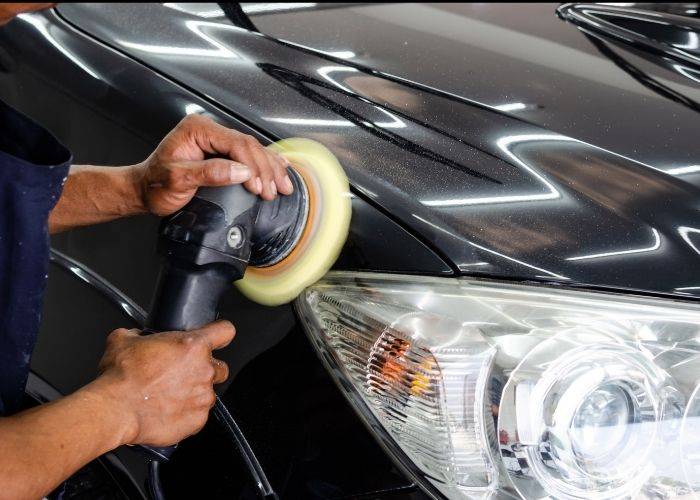
Vehicle owners seeking car paint oxidation restoration in Ephrata often wonder whether surface polishing can revive their paint or if complete repainting is necessary. The deciding factor is total clear coat thickness and structural integrity.
When Machine Polishing and Compounding Works
If UV damage is restricted to the upper 10% to 20% of the clear coat layer, professional paint correction can fully restore clarity and shine.
- Precision Leveling: Dual-action polishers with diminishing micro-abrasives level damaged resin without removing excess clear coat.
- Paint Depth Testing: Technicians utilize ultrasonic paint depth gauges to measure clear coat thickness down to the micron before polishing begins.
When Full Panel Refinishing Is Required
Once clear coat begins flaking or peeling, the protective layer has completely failed. Polishing cannot rebuild lost clear coat.
At this stage, the panel must be sanded down, sealed with corrosion-resistant primer, color-matched to factory specifications, and sprayed with a fresh clear coat in a climate-controlled spray booth.
What You Can Handle vs. When to Call a Pro
Maintaining your vehicle’s paint requires knowing which tasks are safe for home maintenance and which demand specialized body shop equipment.
Tasks Most Car Owners Can Do
- Wash the vehicle regularly in shaded areas using pH-neutral automotive shampoo.
- Apply spray sealants or synthetic waxes every 6 to 8 weeks to maintain surface slickness and UV defense.
- Inspect horizontal panels regularly for early signs of dullness or water-spot etching.
Tasks for Confident DIY Enthusiasts
- Perform chemical iron decontamination and synthetic clay bar treatments to lift embedded road fallout.
- Apply light finishing polish by hand to remove minor wash swirls on healthy clear coats.
When to Call a Professional
- Severe surface hazing, chalky residue, or deep oxidation covering major horizontal panels. Unknown clear coat thickness or prior machine polishing history on thin factory paint.
- Red flags requiring immediate professional attention: White flaking edges, peeling clear coat spots, exposed base coat, or rust spots forming along oxidized seams.
Common Summer Paint Care Mistakes to Avoid
1. Washing Vehicles in Direct Sunlight
What people do wrong: Washing hot car panels under midday summer sun.
Why it’s a problem: Rapid water evaporation bakes mineral deposits into the clear coat, creating deep water-spot etching that requires heavy compounding to remove.
The right approach: Wash your vehicle in shaded areas or during cool early morning hours, and dry panels immediately with microfiber towels.
2. Using Heavy Glazes to Hide Oxidation
What people do wrong: Applying heavy silicone cleaner waxes or glazes over oxidized clear coat.
Why it’s a problem: Silicone fillers temporarily mask surface hazing without removing dead resin. After two or three rain showers, the fillers wash away, exposing the same dull finish.
The right approach: Perform machine paint correction to permanently remove dead clear coat resin before locking in protection with ceramic coatings or polymer sealants.
3. Delaying Action on Early Clear Coat Hazing
What people do wrong: Ignoring minor hazing until clear coat begins peeling away from the base coat.
Why it’s a problem: Once clear coat delaminates, non-invasive machine polishing is no longer possible, forcing you to pay for full panel repainting.
The right approach: Schedule a professional paint evaluation at the first sign of surface dullness or chalkiness.
Conclusion
Summer sunlight in Lancaster County takes a heavy toll on vehicle finishes, but catching clear coat oxidation early allows for safe, professional restoration. Through precision paint depth analysis and multi-stage machine correction, your vehicle’s depth, gloss, and UV defense can be fully restored without expensive repainting.
In our experience, addressing surface hazing before clear coat delamination occurs is the single best way to protect your automotive investment. For paint damage caused by an accident, our sister shop Lititz Collision & Repair handles full collision repair and refinishing.
Noticed your paint looking dull or chalky? Schedule a paint condition assessment with the team at Barry’s Paint Shop today.
Serving Ephrata, Denver, Lititz, Reading, Lancaster, Lebanon, and the surrounding Pennsylvania areas.
Frequently Asked Questions
What does UV paint damage repair in Lancaster PA cost?
Professional UV paint damage repair costs vary based on size and scale of the project. You can read more about how we price jobs in this article.
How do I know if my oxidized paint can be polished or needs repainting?
Your paint can be polished if the clear coat layer is still intact above 1.0 mil of thickness. If you see white flaking, peeling edges, or exposed base coat, the clear coat has failed, and full panel repainting is necessary. A professional shop uses a digital gauge to test clear coat depth.
Can car paint oxidation restoration in Ephrata be done with DIY products?
DIY cleaner waxes and store-bought compounds can temporarily mask light hazing, but they cannot permanently level oxidized resin matrixes. Professional car paint oxidation restoration in Ephrata uses specialized dual-action polishers, micro-abrasives, and thickness gauges to safely eliminate dead clear coat.
How long does professional auto paint restoration in Pennsylvania last?
Professional auto paint restoration in Pennsylvania lasts 2 to 5 years when paired with a quality ceramic coating or high-UV synthetic sealant. Maintaining the finish with regular pH-neutral hand washes and shaded parking further extends protective durability.
Why does summer heat accelerate clear coat damage on vehicles?
Summer heat raises vehicle panel temperatures above 160°F, accelerating UV photo-oxidation and breaking chemical cross-links in clear coat resins. Thermal expansion also stresses paint layer bonds, allowing moisture and environmental contaminants to penetrate faster.
Will polishing my vehicle thin out the clear coat too much?
Professional machine polishing removes only 2 to 5 microns of damaged clear coat, which is a fraction of the total factory layer. Technicians measure clear coat depth beforehand to ensure safe leveling without compromising long-term protection.
Sources
MGA Research Corporation — Why Sunlight is the Most Destructive to Automotive Details — More information about UV rays and how they affect vehicles.
I-CAR — Automotive Refinishing Standards — Industry standards for paint film thickness measurement, clear coat leveling limits, and OEM refinishing procedures.